


Hair health
FREE US MAINLAND SHIPPING OVER $50 · 14-DAY RETURNS
FREE US MAINLAND SHIPPING OVER $50
Single clips
 Every clip sized in inchesAll claw clipsShop all
Shop by hair type
Not sure?
Find your size
Sizes go by the longest side of the closed clip. The guide compares all five, in inches.
Open the size guideClaw clip sets
Sets, already matched.
Each set holds clips picked for one hair type.
Shop all setsMix any single clips, sizes and colors.
Topics
All guides
Hairstyles
The basic twist and clip, step by step, with changes for short, long, thick and fine hair, flat claw clips, and fixes for a clip that will not stay in.
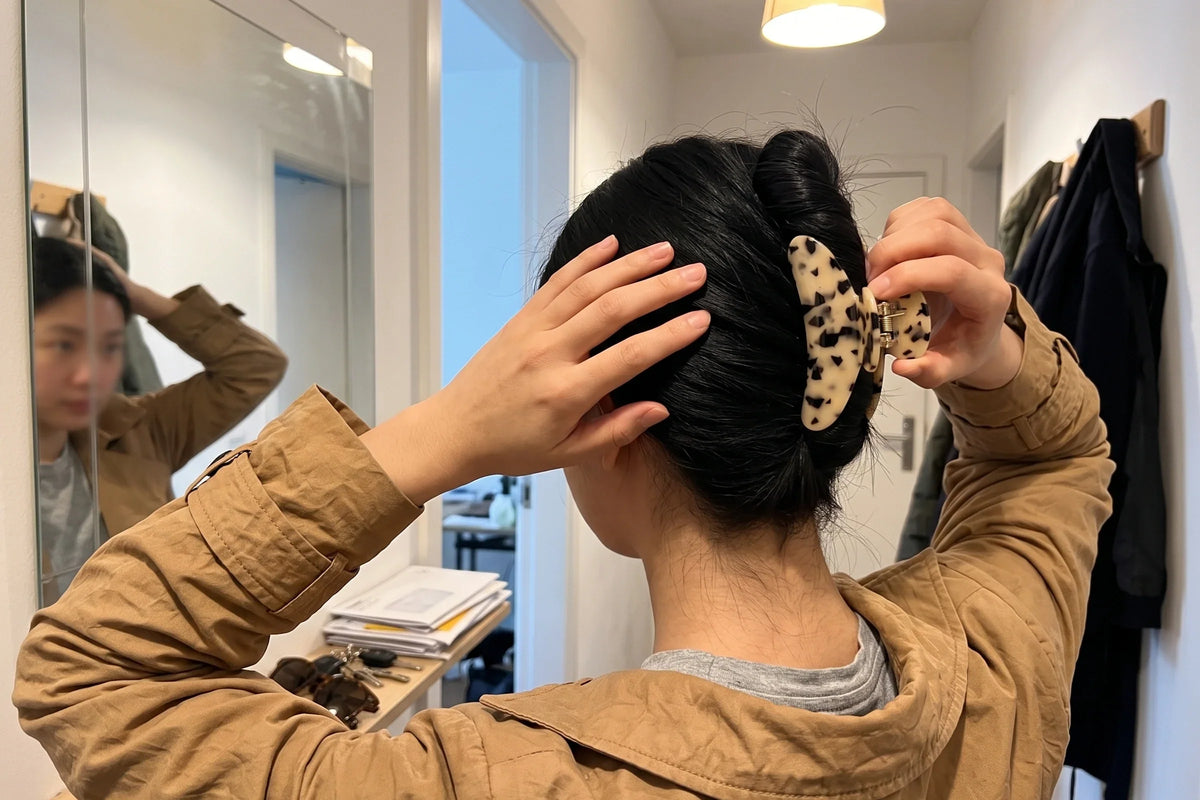
To use a claw clip, gather your hair at the back of your head, twist it into a rope, lay the twist flat against your head, and close the clip over it so the teeth reach the hair underneath. The twist gives the teeth something to hold. The hair against your scalp is what keeps the clip on your head. The rest is adjustment for length and thickness.
This is the standard hold. It works on hair from about shoulder length down, and most other claw clip styles are variations of it. Start with dry, brushed hair and keep the clip within reach.


Step 7 is the one people skip. A clip that holds only the twist is holding a loose rope. A clip whose teeth reach the hair underneath is fastened to your head.
Once this holds, the same move makes a bun, a ponytail or a half-up style. They are laid out in claw clip hairstyles.
The basic method assumes a medium amount of hair at a medium length. If yours is different, change one thing.
Hair that stops between the chin and the shoulders is too short to twist all the way up. Clip the top half only: gather the hair from your temples back to your crown, give it one turn, and close a small clip over it. Or gather everything low at the nape, twist once, turn the twist upward, and clip it close to your neck. The ends will stick out above the clip, which is the look. Loose side pieces can go into mini clips. There is more in claw clip hairstyles for short hair.

Long hair leaves more tail than the clip can cover. After you lift the twist, fold the leftover length back down over it, so the hair is doubled, and clip over both layers. If the clip cannot close over the doubled hair, coil the twist into a bun instead. See claw clip hairstyles for long hair.
Thick hair makes a thick twist. Twist it firmly, because a tight rope takes up less room than a loose one, and use a larger clip. If the clip still cannot close with the teeth meshed, put less hair in it: clip the top half only, or split your hair into two twists with a clip on each. Both are explained in claw clip hairstyles for thick hair.
Fine hair is light, but it is smooth, and a clip that is too large has nothing to press against. Use a smaller clip than you think you need. Twist a little more loosely so the twist stays wide, and push the teeth well in. Freshly washed hair is at its most slippery. A little texture spray where the clip will sit, or a small elastic tied at the nape before you twist, gives the teeth something to hold.
A flat claw clip has a low, flat back instead of a rounded one, so it lies close to your head. That makes it less bulky when you lean back against a sofa, a chair or an exercise mat. The trade-off is depth. There is less room inside a flat clip, so the hair has to be spread wide and thin instead of gathered into a thick rope.
If the clip will not close, there is too much hair in it. Twist more loosely and spread the hair wider, or clip the top half only. Thick or very long hair often suits a flat clip in a half-up style more than in a full twist.
A claw clip that will not stay in, or that keeps falling out, usually has one of six causes. Work through them in order.
Do not solve a slipping clip by pulling your hair tighter. The American Academy of Dermatology notes that hairstyles that pull on the hair, worn often, can lead to hair loss over time. The fix is size and placement, not tension.
If none of this helps, look at the clip itself. A slack spring or a broken tooth will let any style go.
Choose by how much hair goes into the clip, then by length. Our sizes run Mini, Small, Medium, Large and XL.
The test is the same for every size. Closed over your hair, the teeth should mesh or nearly mesh, and the clip should stay put when you shake your head.
Squeeze the clip fully open before you lift it away. Pulling on a half-open clip drags the teeth through your hair and catches strands.

For an upright twist, the clip runs up and down, in line with the twist, with a row of teeth on each side. For a bun, it goes across the middle of the coil. In both cases the teeth point toward your head, and their tips should reach the hair against your scalp.
One that closes around your hair with the teeth meshed, and no larger. If the clip pops open, it is too small. If it closes and hangs loose, it is too large.
Yes, with less hair in the clip. A half-up twist with a small clip works from about chin length, and mini clips hold side pieces. A full twist up the back of the head needs hair of roughly shoulder length or longer.
No. The twist does the job of the elastic. A small elastic underneath helps in two cases: fine or freshly washed hair that slides, and heavy hair worn high, where the elastic carries the weight.


Keep reading
Compare
| Product | SKU | Description | Collection | Availability | Product type | Other details |
|---|
Edit option
